
Berlin’s research landscape drives innovation worldwide
The range of partners, networks and opportunities for collaboration in Brain City Berlin is unmatched anywhere in the world.
Close interdisciplinary cooperation between universities, universities of applied sciences, non-university research institutions and companies leads to forward-looking solutions, making Berlin a vibrant hub for knowledge and technology transfer.
Berlin University Alliance – Berlin’s universities working together
The Berlin University Alliance (BUA) brings together Freie Universität Berlin, Technische Universität Berlin, Humboldt-Universität zu Berlin and Charité – Universitätsmedizin Berlin. Funded as a University of Excellence alliance since 2019, it receives permanent funding of 15 to 28 million euros per year. Its goal is to create a shared, integrated research environment in Brain City Berlin and to further strengthen the city’s position at the highest international level of research.
Clusters of Excellence
In 2018, Freie Universität Berlin, Humboldt-Universität zu Berlin, Technische Universität Berlin and Charité – Universitätsmedizin Berlin jointly received funding approval for seven Clusters of Excellence, with funding starting in January 2019. The funding period was seven years, and around 335 million euros were raised. In the second round of the Excellence Strategy in May 2025, five Berlin Clusters of Excellence were selected for seven years of funding by the federal and state governments from 2026, three of them clusters from the first round. An important strategic boost for the future of Berlin as a location for science and innovation.

Berlin Research 50 – the alliance of non-university research institutions
Berlin Research 50 (BR50), founded in 2020, is the alliance of non-university research institutions in Brain City Berlin. Its members, which cover all fields of research, jointly develop strategies for research, policy and society and facilitate coordination among themselves. The alliance includes institutes of the Leibniz Association, the Max Planck Society, the Helmholtz Association and the Fraunhofer-Gesellschaft, as well as federal government research institutes and the Prussian Cultural Heritage Foundation.
IFAF Berlin – strengthening research at universities of applied sciences
The Institute for Applied Research Berlin (IFAF Berlin) brings together the research expertise of Berlin’s four state universities of applied sciences: ASH Berlin, Berliner Hochschule für Technik (BHT), Hochschule für Technik und Wirtschaft Berlin (HTW Berlin) and Hochschule für Wirtschaft und Recht Berlin (HWR Berlin). With support from the State of Berlin, IFAF Berlin promotes knowledge and technology transfer across institutions, as well as projects on integration, digital cultural transformation and start-up financing. Researchers work closely with nonprofit organizations and small and medium-sized enterprises.

“As SAGE universities, we share a commitment to topics such as social and global justice, gender equity, the promotion of diversity, anti-discrimination and anti-racism, inclusion, social engagement, sustainability in the sense of education for sustainable development, climate justice, social security and good living conditions for all.”
Prof. Dr. Bettina Völter, President of ASH Berlin
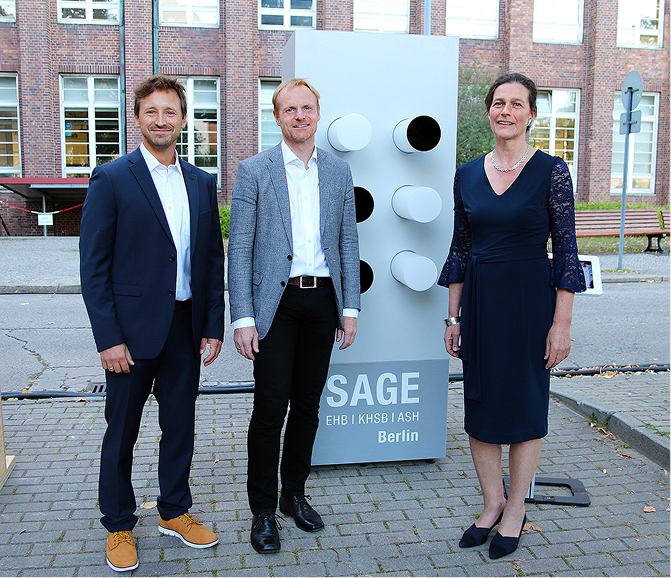
SAGE alliance – greater visibility for degree programs in the social sector
The acronym SAGE stands for the German terms for social work, health, childhood education and education. In 2019, Alice Salomon Hochschule Berlin (ASH Berlin), Evangelische Hochschule Berlin (EHB) and Katholische Hochschule für Sozialwesen Berlin (KHSB) joined forces to form this three-way alliance. Through the SAGE alliance, the universities aim to strengthen their ties with one another and increase the external visibility of higher education in the social sector. All three universities offer degree programs and continuing education that qualify students for SAGE professions.
ECDF – joint research and pioneering alliances
The Einstein Center Digital Future (ECDF) is an initiative funded by the Einstein Foundation Berlin that is dedicated to the digitalization of research. As an inter-university center, it connects researchers from different disciplines, combining innovation with interdisciplinarity to explore one of the most important issues of our time.
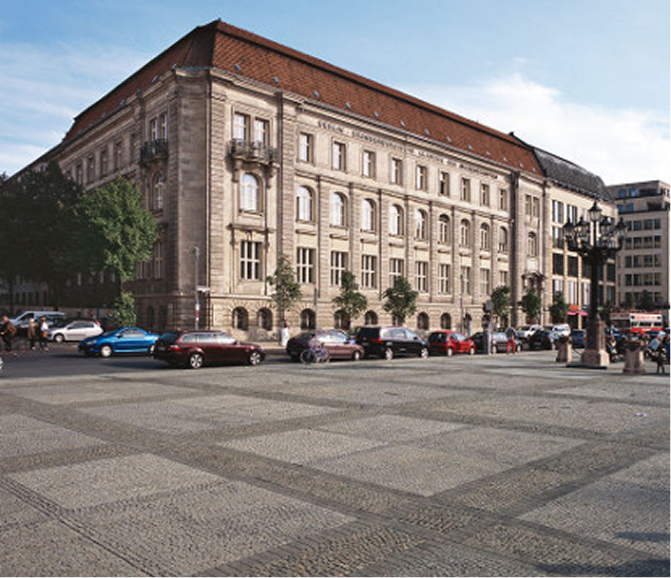
Berlin-Brandenburg Academy of Sciences and Humanities – fostering exchange
The BBAW is an association of outstanding researchers across disciplines and state borders, with a tradition spanning more than 300 years. Eighty Nobel laureates have shaped its history. The BBAW aims to promote research and dialogue between science and society, and to support institutional cooperation between non-university research institutions and universities in Berlin and Brandenburg.
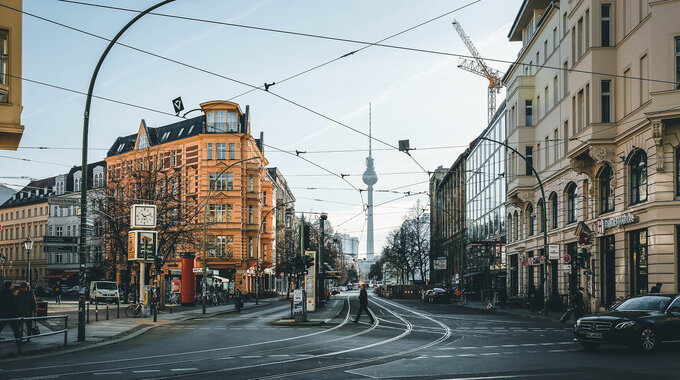
Berlin Zukunftsorte (Future Places)
The State of Berlin supports a total of eleven Zukunftsorte (Future Places), as set out in the State of Berlin’s coalition agreement:
- Adlershof
- Berlin Buch
- Berlin Campus Charlottenburg
- Berlin SÜDWEST
- Berlin TXL – The Urban Tech Republic
- CleanTech Marzahn
- Tempelhof Airport (Flughafen Tempelhof)
- Health Innovation Quarter Berlin-Mitte
- Siemensstadt Square
- Technology Park Berlin-Humboldthain (Technologie-Park Berlin-Humboldthain)
- Berlin Schöneweide Business and Science Location (Wirtschafts- und Wissenschaftsstandort Berlin Schöneweide)
Science festivals
Exchange between science and society is a priority in Brain City Berlin. Citizen science approaches, such as those practiced at the Museum für Naturkunde Berlin and the Futurium, are just as much a part of this as major festivals that draw tens of thousands of people to the city. The major annual events:
LNDW
Every year, the Long Night of the Sciences opens the doors of Berlin’s research landscape to everyone. In 2025, its 25th anniversary year, more than 50 institutions took part and welcomed around 36,000 visitors.
Berlin Science Week
As one of Europe’s leading science festivals, Berlin Science Week transforms the city every November into a lively place of ideas, with around 300 events across Brain City Berlin and a central festival hub. Together, science and society explore how research shapes our world. In 2025, Berlin Science Week took place for the tenth time.
Falling Walls Summit
Building bridges and breaking down walls: every year from November 6 to 9, the Falling Walls Foundation brings renowned experts to Berlin and encourages interdisciplinary discussion about innovation, research and society. A special highlight is the presentation of the “Science Breakthroughs of the Year.”
Transfer Week
Every fall, Transfer Week turns the capital region into a lively meeting place for science, business and start-ups. A week full of workshops, pitches, lab tours and interdisciplinary formats revolves around one question: How can research results become marketable solutions? The week concludes with the presentation of the Berlin-Brandenburg Innovation Award.